The assumption that smart home stuff requires drilling, rewiring, or permanent changes is mostly wrong. I've lived in three apartments and made each one smarter without touching a single screw that wasn't already there. When I moved out, I took everything with me and got my deposits back.
Here's what actually works for renters — not what's technically possible in theory, but what I've personally done or watched friends do without landlord drama.
Rule Zero: No Permanent Changes
Before the list: the boundary is restoration to original condition. Smart plugs, stands, adhesive mounts, and devices that replace things you can put back — all fine. Replacing light switches by disconnecting wires, drilling into walls, or mounting permanent fixtures — not fine without explicit landlord permission. Some landlords will say yes if you ask nicely and offer to restore it. Most won't, and you shouldn't risk the deposit.
With that said, there's a lot of room to work with.
1. Smart Plugs: The Gateway Drug ($14-30 each)
Start here. A smart plug turns any outlet into a smart outlet. Lamp, fan, space heater, coffee maker — anything that plugs in becomes automatable.
Kasa EP25 ($17) supports energy monitoring, which means you'll learn immediately that your old refrigerator is costing you $40/month more than it should. The Tapo P125M ($15) supports Matter for ecosystem flexibility. Both work without a hub, completely renter-friendly, and you take them when you leave.
I have six smart plugs across my apartment. My bedroom lamp turns off automatically 30 minutes after I go to bed. My coffee maker starts 10 minutes before my alarm. My air purifier ramps up when my air quality sensor detects particulates. All plug-in, zero commitment.
2. Smart Bulbs (In Fixtures You're Allowed to Use)
Smart bulbs go into existing sockets. No wiring, no landlord permission needed. The catch: wall switches need to stay on. If someone turns off the switch, the bulb loses power and goes dumb.
Two solutions: put a switch cover over the wall switch (a simple $6 piece of plastic that reminds people not to flip it), or use bulbs that also work with physical dimmer switches.
Philips Hue White A19 ($15) is the premium pick — Zigbee-based, excellent color rendering, works with everything. IKEA Tradfri ($10-15) is the budget Zigbee option that's solid for basic on/off. Sengled Smart Bulbs ($10) are WiFi-based and don't require a hub, good starter option.
For renters: avoid screwing any smart bulb hub/bridge to the wall. The Hue bridge just sits on a surface and plugs in. Take it when you go.
3. Smart Speakers as Hubs ($50-100)
An Amazon Echo (4th gen, $100) or Google Nest Mini ($50) isn't just a speaker — it's the command center for everything else on this list. Set it on a shelf, plug it in, done.
Alexa has better third-party device compatibility. Google Assistant has better natural language understanding. Pick whichever ecosystem your devices support. Both are lease-compliant because they're just plugged in.
If you care about privacy, a local hub like a Raspberry Pi + Home Assistant is technically renter-safe too — it just requires more setup. I run both: Home Assistant for automations, an Echo for voice commands, since Alexa integrates with Home Assistant these days.
4. Smart Thermostats (With a Caveat)
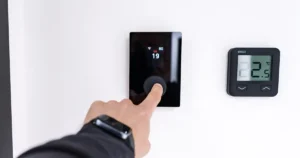
This one requires nuance. A smart thermostat does involve replacing the existing thermostat. However — and this is important — if you save the original thermostat and reinstall it when you move out, many landlords explicitly allow this. Ask first.
The ecobee SmartThermostat Essential ($149) is the best renter-friendly smart thermostat because it includes room sensors, is easy to remove, and is compatible with most systems (check their compatibility checker first). The room sensors are adhesive-mounted and leave no damage.
If your landlord says no, use a smart plug on a space heater/window AC plus a temperature sensor for room-level control. It's not as efficient, but it works.
5. Contact Sensors and Motion Sensors (Stick-On Everything)
Aqara door/window sensors ($15 each) use 3M adhesive tape. They stick to door frames and windows, detect open/close, and come off cleanly. I use them to automate lights (bedroom light turns on when I open the door), monitor if I left windows open, and get alerts if my front door opens while I'm away.
Motion sensors on command strips — same deal. Aqara Motion Sensor P1 ($20) sticks to a wall or sits on a surface. Detects motion, temperature, and light level. Completely removable.
These devices need a hub (Aqara hub $30, or Zigbee stick + Home Assistant). The hub is just another plugged-in device. No installation required.
6. Smart Locks (The Renter-Safe Way)
I covered smart locks in detail in another article, but for renters specifically: look at the Level Lock+ ($329). It replaces just the interior cylinder of your deadbolt and looks completely stock from outside. When you move, reinstall the original cylinder, take your Level Lock, and no one ever knows you had it.
Alternatively, if your landlord uses a doorknob lock rather than a separate deadbolt, a smart lock adapter isn't an option — just use a smart lockbox for key sharing instead.
7. Smart Lights for Rooms Without Ceiling Fixtures
Many apartments have rooms with no overhead lighting, just outlets. This is actually a smart home opportunity. A GOVEE Floor Lamp ($50) or a smart-plug-enabled torchiere lamp controlled by a motion sensor or voice command is functionally identical to smart overhead lighting. I've done this in every apartment bedroom I've lived in.
For under-cabinet or accent lighting, GOVEE LED strips ($25) use 3M adhesive backing, are removable without damage, and support WiFi control. Not the most robust product, but genuinely takes minutes to install and remove.
8. Smart Air Quality Monitor ($50-80)
Renters often can't control their building's HVAC system, but you can know what you're breathing. An Airthings Wave Mini ($80) monitors CO2, humidity, VOCs, and temperature. CO2 levels above 1,000ppm make you sluggish — I didn't know my apartment had consistently high CO2 until I got this. Now I open a window for 10 minutes after cooking and my afternoon energy levels improved noticeably.
It uses Bluetooth/WiFi and just sits on a shelf. Data visible in the Airthings app or integrated into Home Assistant. No installation at all.
What to Do When You Move
Take a 10-minute video walkthrough before you move in documenting the original state of switches, outlets, and fixtures. When you move out, restore everything to what you documented. The smart home pays for itself — I've calculated that my energy monitoring and automated temperature control saves me $30-40/month. After a year, my entire smart home setup paid for itself in utilities alone.
The one thing I'd tell every renter: start with smart plugs, add a voice assistant, then expand based on what frustrates you. Don't over-engineer from day one.
Where to Buy
Affiliate links — if you buy through these links, I may earn a small commission at no extra cost to you.